
1. And input/output relating to the directive
(1) input/output refresh directive REF REF (p) order number is FNC50. FX series PLC Central input/output mode. If you need the latest information and want immediate results you must use the directive. As shown in Figure 3-60, when X0 is switched on, the X10~X17 a total of 8 points will be refreshed when X1 is switched on, Y0~Y7, Y10~Y17, 16–point output will be refreshed.
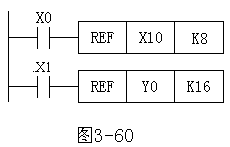
REF directive should be used note:
1) of the destination operand is a symbol numbers in the single digits for 0 x and Y,n should be integer multiples of 8.
2), instruction as long as 16-bit operation, step 5 program.
(2) the filter adjustment instructions REFF REFF (p) order number is FNC51. X0~X17 in the FX series PLC using a digital filter, REFF instructions to adjust the filter time, range 0~60ms (actually due to RL filter at the input port, so the minimum filter for 50 μ s). As shown in Figure 3-61, when X0 is switched on, the REFF instruction is executed, the filter time constant is set to 1ms.
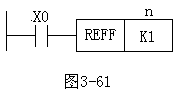
REFF instruction should be used note:
1) REFF for 16-bit arithmetic instructions step 7 procedures.
2) when the X0~X7 speed as high speed counter input, or when using the FNC56 directive and interrupt input, input filter filter time is automatically set to 50ms.
(3) the matrix input MTR MTR instruction number is FNC52. Using the MTR can form a contiguous arrangement of 8 inputs and n outputs 8 input matrices of n rows. As shown in Figure 3-62, [s] X0~X7 specified input 8–point and n outputs Y0, Y1, Y2 (n=3) of an input matrix. PLC MTR instruction is executed at run time, when ON is Y0, reads the first line of the input data, stored in M30~M37; Y1 is ON reading into the second row of the input state, into the M40~M47. Other analogies, repeat

MTR instruction should be used note:
1) source operand [s] is the element number in the single digits for x 0, target operand [D1] is the element number in the single digits for 0 y, destination operand [D2] is the element number in the single digits for 0 y, m and S,n ranges are 2~8.
2) taking into account the input filter response latency to 10ms, for a given output in order of 20ms interrupt immediately.
3) with this directive by 8 point input transistor output with 64 points, but read 64 points at a time, enter the time for 20msx8=160ms, not high-speed input operations.
4) this directive only the 16-bit operation, 9 programs.
2. High speed counter instructions
(1) number of HSCS DHSCS high speed counter set instructions instructions for the FNC53. It applied to high speed counter set, the current value of the counter when the preset value is reached, the counter output contact action immediately. It uses the interrupt enable setting and output immediately and has nothing to do with the scanning cycle. As shown in Figure 3-63, [S1.] Set value (100), when high speed counter C255 current value from 99 to 100 or 101 to 100, Y0 is immediately set to 1.

(2) high-speed HSCR DHSCR speedometer reset instructions instruction number is FNC54. As shown in Figure 3-63, C254 current values by 199 to 200 or 201 to 200, the disruptive way Y10 are used immediately reset.
HSCS and HSCR should be used note:
1) source operand [S1.] All data types, [S2.] For C235~C255, the target operand y, m, and s.
2) only the 32-bit operation, accounting for 13 programs.
(3) high speed speedometer range compare HSZ DHSZ order number is FNC55. As shown in Figure 3-63, destination operand is Y20, Y21 and Y22. C251 when the current value of <K1000, Y20 is the current value ≤ ON;K1000 ≤ C251 K1200, Y21 ON;C251 when the current value of >K1200, Y22 is ON.
Speed interval COMP speedometer should be used note:
1) operand [S1.], [S2.] All data types, [s.] For C235~C255, the target operand [d.] Y, m, and s.
2) instructions for 32-bit operation, accounting for 17 programs.
2. Speed test instructions
Speed directive–SPD number is FNC56. Its function is used to detect from the encoder input pulses within a given time, and calculate the speed. As shown in Figure 4-64, the [d.] Three components. When X12 is ON, with D1 to X0 input rising edge count, count results into the D0,D1 after 100ms reset counts the X0 D1. D2 calculating remaining time after the counting ended.

Speed test instructions should be used note:
1)[S1.] X0~X5,[S2.] All data types are desirable, [d.] T, c, d, v, and z.
2), instruction only 16-bit operation, step 7 procedures.
3. Pulse output commands
Pulse output (d) PLSY number is FNC57. It is used to produce a specified number of pulses. As shown in Figure 3-65, [S1.] Used to specify the pulse frequency (2~20000Hz), [S2.] Specifies the number of pulses (range 16-bit instructions for 1~32767, a 32-bit instruction for 1~2147483647). If the specified number is 0, then produce an infinite number of pulses. [D .] Used to specify pulse output device. The duty cycle of the pulse 50%, pulse output in interrupt mode. Specified pulse output after the finish flag M8029 set to 1. When X10 from ON to OFF, M8029 reset, stop the output pulse. If X10 becomes ON pulse output from scratch.

Pulse output commands should be used note:
1)[S1.]、[S2.] All data types are desirable, [d.] For the Y1 and Y2.
2) may 16 and 32-bit operation of the directive, take up program step 7 and 13, respectively.
3) this directive can only be used once in a program.
5. PWM command
PWM pulse width modulation instruction number is FNC58. Its function is used to generate the specified pulse width and cycle of the pulse train. As shown in Figure 3-66, [S1.] to specify pulse width, [S2.] Used to specify the pulse cycle, [d.] Used to specify the element number of the output pulse (Y0 or Y1), output on/off status controlled by the interrupt mode.

Be aware of when using pulse width modulation instructions:
1) operand type identical to PLSY; only 16-bit operation of the directive, step 7 program you want.
2)[S1.] Should be less than [S2.].
6. Adjustable-speed pulse output
Adjustable-speed pulse output of the directive (d) PLSR number is FNC59. The output pulse can be accelerated with the instruction, may also be slow to adjust. Source and destination operand has the type of the operands and PLSY instructions are the same, only for transistor PLC Y0 and Y1, can be 16-bit or 32-bit operation, 9 and 17 respectively program steps. The directive can only be used once.
 PLC ONE